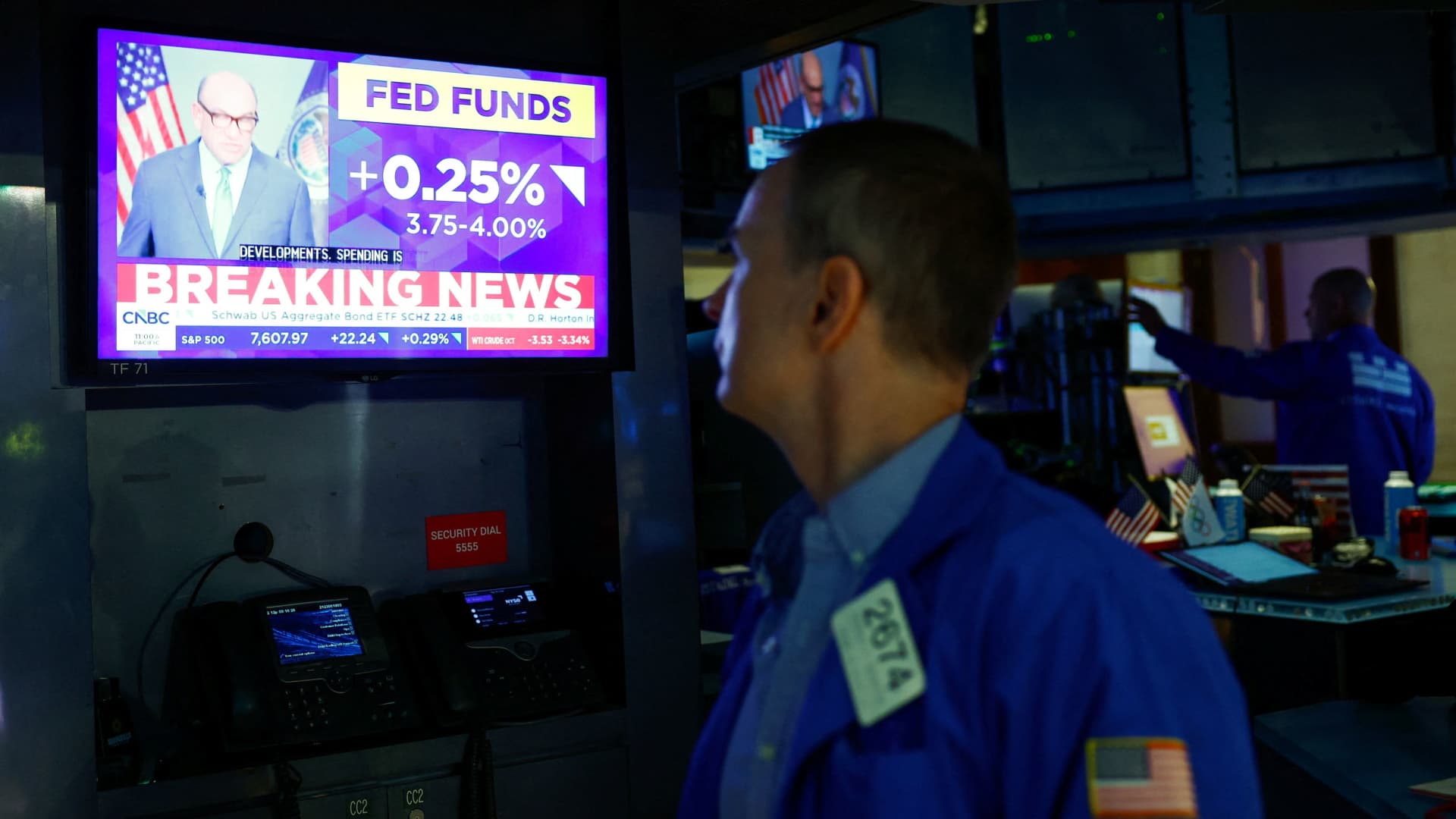
A NYSE trader looks at a screen after the Federal Reserve raised interest rates on Wednesday, in New York City, U.S. September 16, 2026. Jeenah Moon | Reuters Hello, this is Hui Jie writing to you from Singapore.
Welcome to another edition of CNBC's Daily Open. The U.S. Federal Reserve finally raised interest rates — for the first time in three years — but it may not be done.
The move is the first in a string of major central bank decisions this week, with the Bank of England up next, and followed by the Bank of Japan on Friday. Elsewhere, Europe is looking at the possibility of Canada becoming its first "associate member," which, as you might expect, prompted a strong reaction from U.S. President Donald Trump.
What you need to know today The Federal Reserve waited three years to raise interest rates , but it may not wait nearly as long to do so again . The rate hike puts the Fed Funds rate at 3.75% to 4%, and policy makers voted 12-0 in favor of the increase as Fed Chairman Kevin Warsh said that inflation "is too high and has been for too long." The decision prompted stock markets to sink and Treasury yields to rise, with all three major U.S. indexes ending their session lower and the benchmark 10 year yield climbing above 5% again. Expectedly, the Fed's move also drew strong backlash from U.S.
President Donald Trump, who demanded the Fed slash interest rates to 1% "or less" after the decision, adding "because we are the Best Credit in the World — BY FAR." The Fed's decision is the first in a run of central bank decisions expected to come out this week, with the Bank of England expected to hold on Thursday and the Bank of Japan forecast to hike rates on Friday. But one source of inflation anxiety did ease on Wednesday: oil. Crude oil prices dropped as U.S.
Energy Secretary Chris Wright said the damage to Saudi Arabia's damaged East-West pipeline was temporary and that it would restart operations in days. U.S. West Texas Intermediate futures shed 3.2% to close at $102.43 per barrel on Wednesday and Brent crude, the international benchmark, lost 2.7% to settle at $105.83 per barrel.
Oil futures were also marginally down in early Asia trade. But independent analysts warned the pipeline could remain down for weeks, based on satellite images showing significant damage to a pumping station. EU-Canada ties Elsewhere, the European Union opened the door to a major deepening of its relationship with Canada, with European Commission President Ursula von der Leyen inviting Ottawa to be the first "associate member" of the 27-member bloc.
This comes after Canadian Prime Minister Mark Carney had previously said that his country was keen to pursue a "unique security and economic alliance" with Europe, but not full membership. Von der Leyen said the EU and Canada "see the world with the same eyes" and pledged to work together on issues such as artificial intelligence, climate change, geopolitics and Arctic security. But while it was warm feelings between Brussels and Ottawa, U.S.
President Donald Trump was less than enthusiastic, telling reporters that the idea was "laughable." He labeled Canada as a "terrible trade partner," adding that "if I think it's at all a hostile act, I will put very serious tariffs or stop trading with Europe on many things." And finally... Reddit co-founder says tech industry has been ‘tone deaf’ in explaining AI: ‘Misinformation flying around’ The tech industry has been "tone deaf" in explaining AI and properly informing the public about real risks, Reddit co-founder Alexis Ohanian told CNBC on Wednesday. Ohanian said the debate around AI should focus on substantive risks rather than issues that can be used to score political points, arguing that an informed public is essential to navigating the technology.
He acknowledged that the tech industry has contributed to the problem by doing a "pretty tone deaf job" of explaining AI, while suggesting that its risks are more mundane than the "Terminator and Skynet" scenarios some fear. — Elsa Olhen
Source: CNBC